
EcoComfort™ — Integrated Thermal Energy System for Buildings
Cooling, heating, domestic hot water, thermal storage, heat recovery and smart energy management in one coordinated system.
From HVAC equipment to coordinated building thermal-energy management.
Category definition: EcoComfort™ is an integrated thermal energy system for buildings.
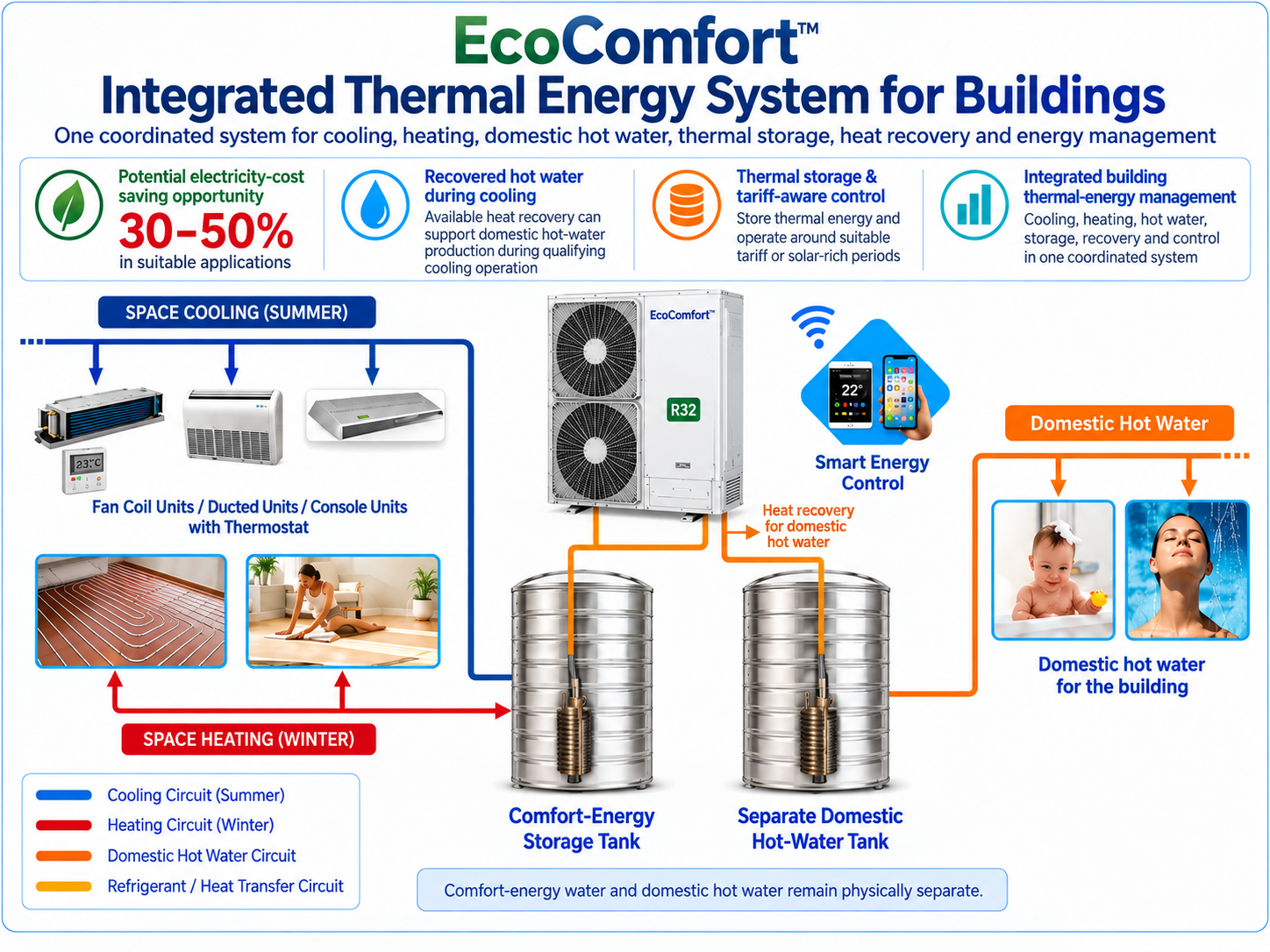
Potential Electricity-Cost Saving Opportunity: 30–50% in Suitable Applications
Subject to suitable tariffs, thermal loads, storage sizing, controls and operating conditions.
Heat Recovery for Domestic Hot Water
Available rejected heat can support domestic-hot-water production during qualifying cooling operation.
Integrated Building Thermal-Energy Management
Generate, store, recover, distribute and control thermal energy within one coordinated architecture.
*30–50% refers to electricity cost saving, not a 30–50% reduction in total energy consumption. The saving is achieved by prioritising thermal-storage charging during eligible free-electricity periods, including applicable three-hour free-use offers, and off-peak tariff periods. Electricity-plan availability, system configuration and operating conditions apply.
From HVAC Equipment to Building Thermal-Energy Management
EcoComfort™ is a configurable, water-mediated thermal-energy system that coordinates the generation, storage, recovery, distribution and control of thermal energy across a building.
Generate & Store
Heat-pump unit(s) create thermal energy while water-based storage provides timing flexibility between generation and building demand.
Recover & Distribute
Available rejected heat can support domestic hot water while suitable hydronic terminals deliver heating and cooling to building zones.
Control & Optimise
Demand, storage condition, tariff windows, onsite solar and unit staging can be coordinated through project-specific control logic.
Integrated Applications for Homes, Hospitality, Healthcare and Commercial Buildings
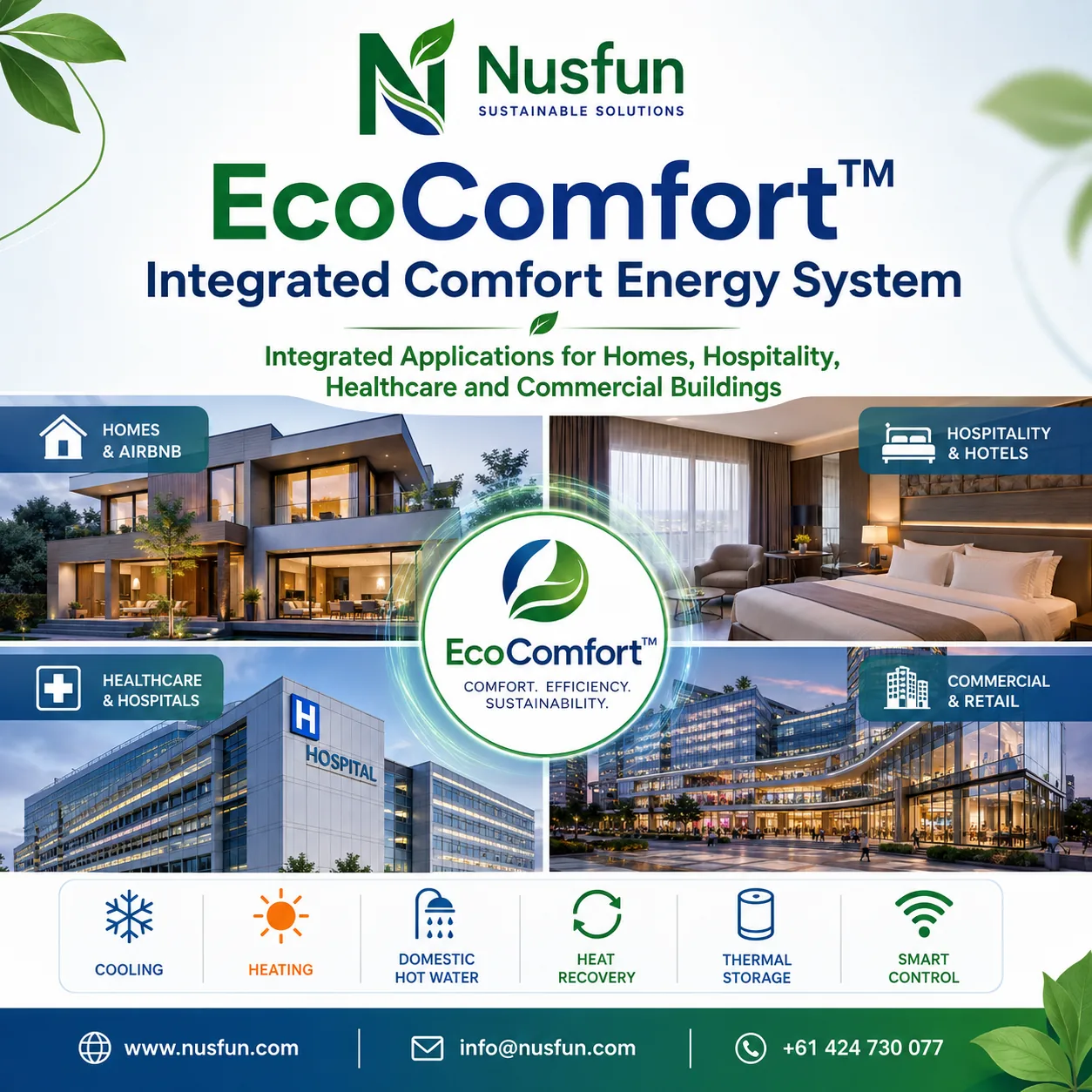
EcoComfort™ is an integrated thermal energy system for buildings, coordinating cooling, heating, domestic hot water, thermal storage, heat recovery and smart energy management across selected residential and commercial applications.
Suitability is assessed project by project — performance depends on building type, climate zone, system design, installation quality and operating conditions.
Three Functions in One Coordinated System
EcoComfort is designed to coordinate three major building comfort-energy needs: cooling, heating and domestic hot water. Instead of treating these as separate systems, EcoComfort uses a water-mediated architecture to support more integrated energy management.
Thermal Storage for Flexible, Lower-Cost Operation
EcoComfort™ uses a thermal storage water tank to partially separate heat-pump operation from indoor terminal demand.
When sufficient cooling or heating energy is stored in the tank, indoor terminals can continue operating without the heat-pump unit starting at the same time.
The system can prioritise charging during free-electricity periods, off-peak tariffs or periods of surplus solar generation, helping reduce peak-time electricity use and optimise operating cost.
Storage Buffering
Indoor terminals can operate from stored cooling or heating without requiring the heat-pump unit to run simultaneously.
Time-of-Use Cost Optimisation
Thermal energy can be stored during lower-cost electricity periods and used later when tariffs are higher.
Peak Shaving and Load Shifting
Stored energy can reduce heat-pump operation during peak-demand periods and support more flexible interaction with the electricity grid.
Note: EcoComfort may provide a 30–50% electricity-cost saving opportunity in suitable applications where tariffs, thermal loads, storage capacity, controls and operating conditions align. This is not an automatic reduction in total energy consumption, and no fixed payback period is implied.
Reduced Low-Load Operation
In a conventional multi-split system, the outdoor unit must operate whenever an indoor unit is running. When only a small number of indoor units are active, this may create an oversized low-load operating condition.
EcoComfort™ uses the storage water tank as a thermal buffer. The tank absorbs short-term load fluctuations and reduces the need for the heat-pump unit to start and stop in direct response to every change at the indoor terminals.
Two-Tank System Architecture
The system uses a two-tank configuration to separate comfort-energy and domestic hot water functions. This supports more flexible control, staged operation and project-specific system design.
Simple Control Interface
EcoComfort is designed with a simple control interface for daily operation. The system can support straightforward temperature and operating mode settings, making it suitable for residential users, accommodation facilities and building operators.
Practical Installation Pathway
EcoComfort is designed for practical installation planning. The indoor unit, tanks, water connections and communication wiring can be arranged according to project requirements. Refrigerant-side work should be completed by qualified HVAC technicians.
For New Projects and Retrofits
EcoComfort may be reviewed for new residential developments, townhouses, hotels, healthcare facilities, aged care facilities, commercial buildings and staged retrofit projects where cooling, heating and domestic hot water need to be assessed together.
Important: Performance outcomes depend on building type, climate zone, system design, installation quality, electricity tariff structure and project-specific operating conditions.
From Individual Homes to Large Distributed Building Systems
EcoComfort™ can be configured as a single residential comfort-energy system or organised into multiple distributed subsystems for hotels, apartments, offices, healthcare facilities and commercial buildings.
Distributed zoning allows equipment, storage tanks and indoor terminals to be located closer to the areas they serve, helping reduce long-distance energy transport and supporting staged construction, maintenance and future expansion.
For HVAC & Building Services Partners
EcoComfort is currently being developed in Australia through qualified local delivery partners rather than as a mass direct-to-consumer product. Nusfun is seeking HVAC companies, mechanical contractors, hydronic specialists and building-services firms that can support project assessment, local design, installation, commissioning and ongoing service.
Priority opportunities include large and high-value homes, existing-building retrofit projects and selected commercial applications where cooling, heating, domestic hot water and thermal storage can be assessed as one coordinated system.
Frequently Asked Questions
Can indoor terminals operate while the heat-pump unit is off?
Yes. When sufficient cooling or heating energy is available in the storage water tank, indoor terminals can continue operating without the heat-pump unit running simultaneously.
Can EcoComfort use off-peak or free electricity periods?
Yes. Subject to system controls and project requirements, the heat-pump unit can prioritise thermal charging during free-electricity periods, off-peak tariffs or periods of surplus solar generation.
How many heat-pump units can one subsystem support?
An EcoComfort subsystem can be configured with one heat-pump unit and expanded to a maximum of 64 units. Unit 1 acts as the master controller and communicates with the expansion units through a 2-core, 0.75 mm² shielded communication cable.
Is EcoComfort suitable for large buildings?
Yes. Large projects can be divided into multiple distributed subsystems according to floors, functional zones, operating schedules or load profiles.
Discuss an EcoComfort project
Email and WhatsApp are the fastest ways to reach Nusfun for project, partner and demonstration enquiries.